
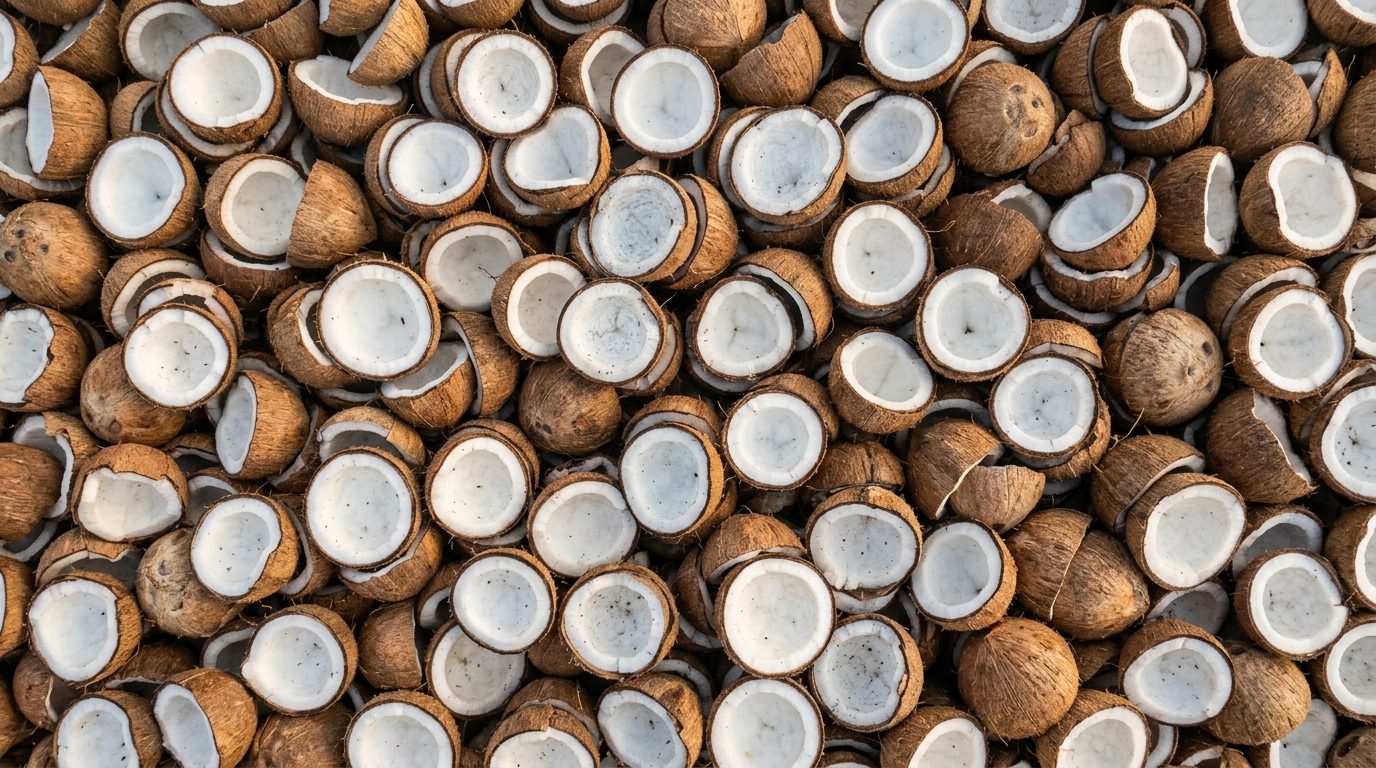
1. Why Tiptur Copra Commands a Global Sourcing Premium
Across the international dried fruit and edible nuts sector, Tiptur—a vibrant taluk located in Tumkur District, Karnataka—is revered as the Coconut Capital of India. The Agricultural Produce Market Committee (APMC) in Tiptur handles the largest volume of high-grade copra in South Asia. But what makes this geographical origin fundamentally superior to coastal copra from Kerala, Tamil Nadu, the Philippines, or Indonesia?
The answer lies in geography and soil chemistry. Tiptur sits on an inland plateau elevated at roughly 850 meters above sea level. Unlike humid coastal coconut belts that suffer from excessive sea salt saturation and perennial dampness, Tiptur boasts an arid, subtropical climate with well-drained, nutrient-dense red loamy soil. These environmental parameters force the coconut palm (Cocos nucifera) to develop an exceptionally thick endosperm kernel packed with concentrated natural sugars and medium-chain triglycerides.
When dried, Tiptur copra retains an oil content routinely exceeding 68% to 70%, whereas standard commercial coastal copra averages just 60% to 63%. For retail consumers, this yields an intensely sweet, nutty crunch without any soapy aftertaste. For milling operations, it delivers unprecedented oil extraction yields per metric ton.
2. The Visual & Tactile Identification Framework
When inspecting physical container samples or pre-shipment lots, experienced commodity surveyors evaluate copra across four distinct sensory metrics:
- Endosperm Color & Translucency: Premium edible Tiptur copra presents an interior meat that ranges from pristine pearlescent ivory to warm cream. It should never appear chalky dead-white (a telltale indicator of artificial chemical bleaching) nor dark grey-black (indicative of fungal infestation or thermal scorching).
- Half-Cup Geometry & Cup Integrity: Genuine Tiptur copra is celebrated for its spherical symmetry. Our processing lines sort whole harvested nuts into unbroken, uniform half-cups. Rejection rates for fractured cups or ragged pieces in Grade 1 retail lots must be strictly capped below 2.0%.
- Kernel Thickness & Toughness: Measure the dried meat wall using vernier calipers. Premium Tiptur copra features a meat wall thickness of 8mm to 12mm. Thin-walled copra (<6mm) originates from immature harvests, resulting in brittle breakage and excessive dust during ocean shipping.
- Outer Husk Cleanliness: The outer shell membrane should exhibit a smooth, golden-brown hue, entirely free of clinging fibrous husk strings, dirt, or insect burrow marks.
Take a random half-cup from the consignment and break it across your thumbs. Cured copra with optimal moisture (<6%) will produce a sharp, clean audible crack like tempered ceramic. If the cup bends, tears with fibrous resistance, or feels rubbery, the moisture level exceeds 7.5%—guaranteeing container sweat, mold, and fatty acid degradation during sea transit.
3. The Sulfur-Free Mandate: Sun-Curing vs. Chemical Sulfur Fuming
The single greatest compliance hazard in international copra procurement is sulfur dioxide (SO2) contamination.
In cheap commercial drying yards, processors routinely stack damp or moldy copra inside closed mud kilns and ignite cakes of industrial sulfur beneath them. The dense sulfur fumes chemically bleach out dark mold spots, kill weevils, and force an artificial bright white sheen onto low-grade kernels. While this masks inferior sourcing, it leaves toxic sulfurous residues ranging from 500 to 2,500 ppm.
Under European Food Safety Authority (EFSA), US FDA, and Gulf Cooperation Council (GSO) regulations, copra containing sulfur dioxide residues above designated thresholds is strictly illegal for direct human consumption and subject to mandatory port rejection or incinerated disposal.
The RBN EXIM Purity Standard: RBN EXIM guarantees 100% sulfur-free copra. Our copra is cured using dedicated solar greenhouse domes and sun terraces in Tiptur. Solar drying utilizes natural UV radiation to sterilize bacteria and moisture without introducing any chemical fumes. Every batch is certified with zero detectable SO2 by accredited independent testing laboratories prior to vessel loading.
4. Technical Specification Matrix: Grade 1 vs. Commercial Milling Copra
Before finalizing purchase contracts, ensure your purchase order reflects the following verified laboratory parameters:
| Analytical Parameter | RBN EXIM Grade 1 Edible | Commercial Milling Grade | Testing Methodology |
|---|---|---|---|
| Oil Content (Dry Basis) | > 68.0% - 71.0% | 60.0% - 64.0% | Soxhlet Solvent Extraction |
| Moisture Content | < 5.5% (Max 6.0%) | 7.0% - 9.0% | Karl Fischer / Oven Drying ASTM |
| Free Fatty Acids (FFA as Oleic) | < 1.0% | 2.5% - 5.0% | AOCS Ca 5a-40 Titration |
| Sulfur Dioxide (SO2) | NIL / Not Detectable | 500 - 2,000 ppm (Bleached) | Monier-Williams Distillation |
| Aflatoxin B1 | < 2.0 ppb (Total < 4 ppb) | Often > 20 ppb (Uncontrolled) | HPLC Fluorescence Detection |
| Impurities & Foreign Matter | < 0.25% | 1.5% - 3.0% | Mechanical Screen Gravimetry |
| Broken Half Cups | < 2.0% | 10.0% - 25.0% | Visual Count per 100kg |
| Shelf Life Stability | 12 Months (Sealed Cool Dry) | 3 - 5 Months | Accelerated Rancidity Testing |
5. Packing, Container Stuffing & Maritime Transit Protection
Even the highest quality copra can spoil during a 20-day ocean voyage if packaging and container stuffing lack proper moisture-proofing. Copra is an organic, hygroscopic commodity; when exposed to temperature fluctuations inside a metal ocean container, moisture migrates and condenses on container ceilings, a phenomenon known as container rain.
To guarantee factory-fresh arrival at destination ports like Jebel Ali (Dubai), Jeddah, Singapore, Rotterdam, or New York, RBN EXIM implements rigorous cargo safeguarding protocols:
- Breathable Food-Grade Packaging: Hand-packed into 25kg or 50kg virgin woven polypropylene (PP) bags designed with specialized micropores that permit moisture dissipation while blocking external contaminants.
- Industrial Container Desiccants: We hang multiple high-capacity calcium chloride desiccant poles (absorbing over 200% of their weight in moisture) along the corrugated container interior walls.
- Kraft Paper & Corrugated Floor Liners: Container decks and side walls are fully lined with heavy-duty Kraft barrier paper to insulate bags from direct contact with steel panels.
- Direct Loading from Inland Tiptur: Our consignments are packed immediately after sorting, dispatched via sealed trucks to New Mangalore Port or Chennai Port, and placed into vessel stacks without intermediate outdoor warehouse staging.