
1. Incoterms 2020: The Operational Legal Boundaries
Published by the International Chamber of Commerce (ICC), Incoterms 2020 govern rights, costs, and risk allocations between international buyers and sellers. When procuring bulk agricultural commodities from India, two terms dominate 95% of all sea freight contracts:
- FOB (Free On Board - Named Port of Origin): RBN EXIM bears all costs and regulatory risks up to the physical loading of the container on board the vessel nominated by the buyer at the specified Indian port (e.g., FOB Nhava Sheva or FOB New Mangalore). From the instant the container is latched on board, maritime freight charges, marine insurance, and in-transit ocean risks transfer entirely to the buyer.
- CIF (Cost, Insurance & Freight - Named Port of Destination): RBN EXIM pays for the purchase price, export clearance, inland logistics, ocean freight carriage, and procures marine cargo insurance to the named foreign discharge port (e.g., CIF Jebel Ali, CIF Rotterdam, or CIF Singapore). Risk transfers when goods are on board, but the seller guarantees ocean freight and insurance delivery up to the destination port quayside.
2. Responsibility Matrix: FOB vs. CIF Under Incoterms 2020
Before issuing purchase confirmations, align your logistics division with the exact operational division of duties:
| Operational Component | FOB Terms (Free On Board) | CIF Terms (Cost, Insurance, Freight) |
|---|---|---|
| Inland Transit from Tiptur to Port | Borne by RBN EXIM (Seller) | Borne by RBN EXIM (Seller) |
| Export Customs Clearance & Duty | Borne by RBN EXIM (Seller) | Borne by RBN EXIM (Seller) |
| Terminal Handling Charges (Origin THC) | Borne by RBN EXIM (Seller) | Borne by RBN EXIM (Seller) |
| Point of Risk Transfer | On Board Vessel at Indian Loading Port | On Board Vessel at Indian Loading Port |
| Ocean Freight Booking & Cost | Contracted & Paid by Foreign Buyer | Contracted & Paid by RBN EXIM |
| Marine Cargo Insurance Policy | Arranged & Paid by Foreign Buyer | Procured by RBN EXIM (Min 110% Value) |
| Ocean Demurrage / Detention Risk | Buyer's Forwarder Account | Managed via RBN EXIM Contracted Liners |
| Destination Port THC & Import Duties | Borne by Foreign Buyer | Borne by Foreign Buyer |
3. Strategic Advantages: When Should Importers Choose FOB?
FOB is exceptionally advantageous for:
- Global Conglomerates with Multi-Lane Volume Contracts: Large food corporations (e.g., Unilever, Nestlé, Cargill) negotiate global service contracts with major shipping alliances (2M, Ocean Alliance). Their volume rebates yield ocean freight rates lower than what any single exporter can procure.
- Supply Chains Requiring Complete Vessel Control: Importers who operate their own chartered vessels or have dedicated freight forwarders coordinating multi-origin consolidation in Singapore or Dubai prefer FOB to control arrival timelines precisely.
- Centralized Marine Open Covers: Enterprises maintaining global marine cargo insurance policies with zero deductibles often prefer insuring shipments under their corporate policy rather than accepting third-party policies.
4. Strategic Advantages: Why Most Buyers Prefer CIF
For small, medium, and fast-scaling enterprise importers, CIF is overwhelmingly the superior financial choice:
- Fixed Landed Cost Predictability: Under CIF, you lock in a firm landed price per metric ton. You are completely insulated from sudden bunker fuel adjustments (BAF), currency surcharges (CAF), or peak season freight rate spikes that occur during ocean transit.
- Established Carrier Relationships in India: RBN EXIM holds direct commercial volume contracts with premier carriers including Maersk, MSC, CMA CGM, and Hapag-Lloyd. We secure priority container allocation, guaranteed equipment release at inland depots, and fast berthing at Indian gateways.
- Zero Shipping Hassle: Your logistics team avoids managing vessel delays, feeder transshipment coordination, and origin shipping paperwork. You simply receive the original Bill of Lading (B/L) and take delivery at your destination berth.
Under standard Incoterms 2020 CIF rules, the seller is technically only obligated to provide minimum coverage under Institute Cargo Clauses (C) (which excludes rough handling, maritime sweat damage, and valve leakage). RBN EXIM rejects minimum coverage: on all CIF shipments, we automatically endorse comprehensive Institute Cargo Clauses (A) "All Risks" insurance covering 110% of CIF invoice value, protecting buyers against flexibag puncture, container contamination, rough weather shifts, and general average.
5. Payload Economics: Flexibags vs. 200L Drums vs. IBC Totes
When calculating landed cost per metric ton of bulk Virgin Coconut Oil, Expeller Coconut Oil, or Refined Castor Oil, packaging selection determines your actual container freight efficiency:
| Packaging Type | Container Type | Max Net Payload | Ocean Freight Cost / MT Index | Handling Overhead |
|---|---|---|---|---|
| Single-Use Multi-Layer Flexitank | 20ft Dry Box (FCL) | 21.0 - 21.5 MT | Base Benchmark (Lowest Cost) | Direct Pump Discharge; Zero Drum Discard |
| 1,000L IBC Totes (Composite) | 20ft Dry Box (18 Totes) | 16.2 - 17.5 MT | + 22% vs Flexitank | Forklift Friendly; Reusable Storage |
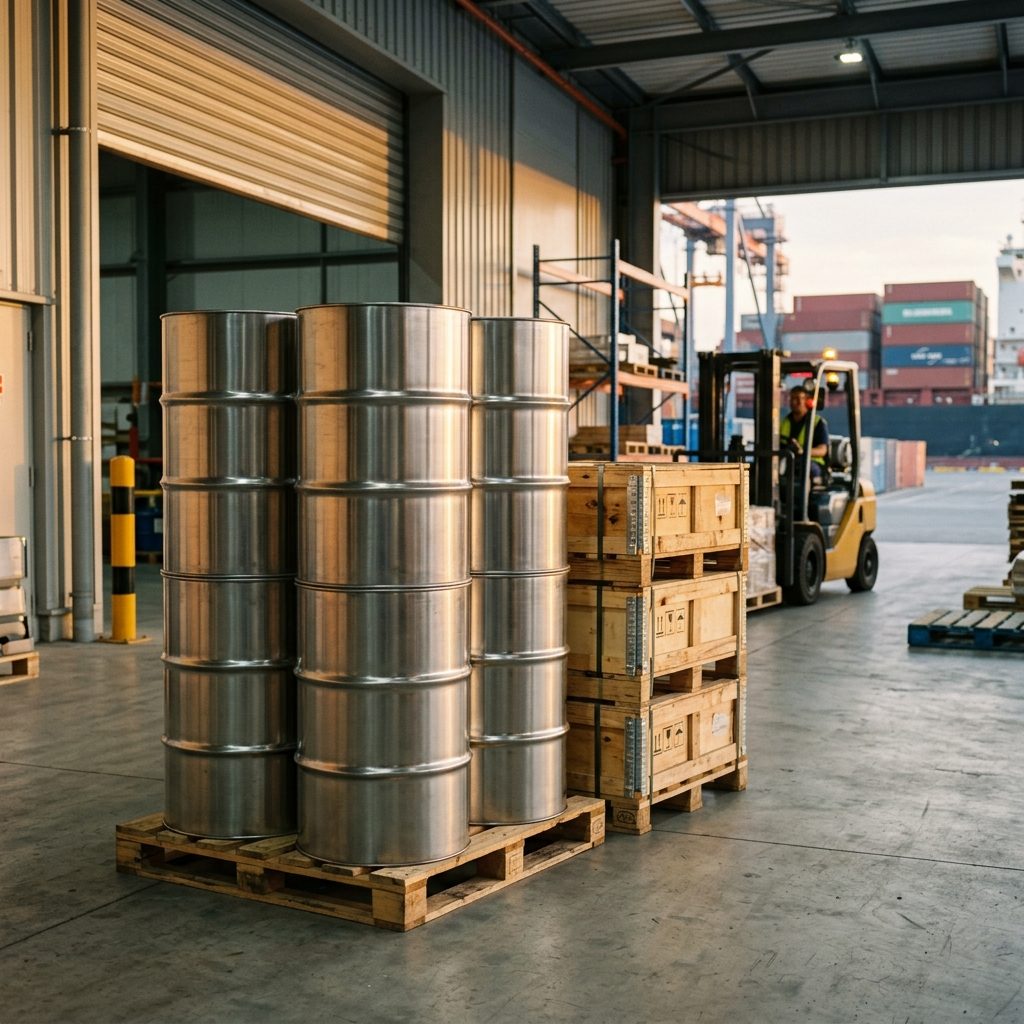
| 200L Epoxy-Lined Steel Drums | 20ft Dry Box (80 Drums) | 15.2 - 16.0 MT | + 32% vs Flexitank | Manual Drum Decanting; High Tare Weight |
| ISO Tank Container | Dedicated ISO Tank | 22.0 - 24.0 MT | Variable (+ High Repositioning Fees) | Requires Specialized Tank Cleaning Facility |
6. Dispatch Gateways: Strategic Indian Seaport Corridors
Depending on your destination market, RBN EXIM dispatches from three high-efficiency container terminals:
- New Mangalore Port (NMPT): Located just 280km from our Tiptur production belt via national highway corridors. Prime gateway for breakbulk copra and containerized feeder vessels servicing Colombo, Dubai (Jebel Ali), and Mombasa with rapid transit times (5 to 9 days to the Arabian Gulf).
- Chennai Port (CCMA): Connected via electrified rail and container freight stations (CFS). Direct sailings to Southeast Asia (Port Klang, Tanjung Pelepas, Singapore, Manila) with weekly rotations.
- Nhava Sheva (JNPT Mumbai): India's largest container gateway, handling direct mother-vessel calls for North America (USEC/USWC) and Northwest Europe (Rotterdam, Antwerp, Felixstowe). Bypasses transshipment hubs, reducing total ocean transit time by up to 10 days.