
1. The Raw Material Dilemma: Fresh Milk vs. Dried Copra
In international commerce, both products carry the broad trade description of coconut oil, yet their raw material inputs are fundamentally distinct:
Virgin Coconut Oil (VCO - HS Code 15131100): True VCO is derived solely from the fresh, mature meat of freshly harvested coconuts within 48 hours of dehulling. The fresh white kernel is grated and mechanically pressed to yield rich coconut milk emulsion. This emulsion is then separated—either through cold centrifugal separation or controlled low-temperature fermentation—without ever drying the meat into copra. The resulting oil remains 100% unrefined, unbleached, and non-deodorized (non-RBD).
Mechanical Expeller Coconut Oil (HS Code 15131900): Expeller oil is produced from sun-dried or kiln-dried copra half-cups. The dried copra is shredded into coarse flakes and fed into a continuous heavy-duty mechanical screw press (expeller). Frictional pressure squeezes out the oil, leaving behind a fibrous byproduct known as coconut expeller cake (copra meal).
2. Thermodynamics: Heat Generation & Thermal Degradation
The defining technical dividing line between these two extraction pathways is temperature control:
- Cold-Pressed Processing (< 49°C / 120°F): Genuine cold-pressing mandates that at no stage during extraction does the temperature of the mash or oil exceed 49°C. At RBN EXIM, we employ traditional wooden cold presses (known locally as Marachekku or Ghani) and chilled hydraulic presses where natural timber absorbs frictional heat. Operating at low RPMs prevents thermal degradation of natural polyphenols, squalene, and delicate volatile aromatic esters.
- Mechanical Screw Expeller Processing (75°C - 95°C+): In standard continuous industrial expellers, the rotating worm shaft compresses copra against rigid steel barrel bars under immense pressure (often exceeding 1,000 psi). This mechanical shearing naturally generates internal friction temperatures between 75°C and 95°C, and occasionally above 110°C if cooling jackets are not operational. While this maximizes oil yield per ton, thermal exposure causes mild caramelization of residual sugars, imparting a darker golden-yellow tint and a toasted aroma.
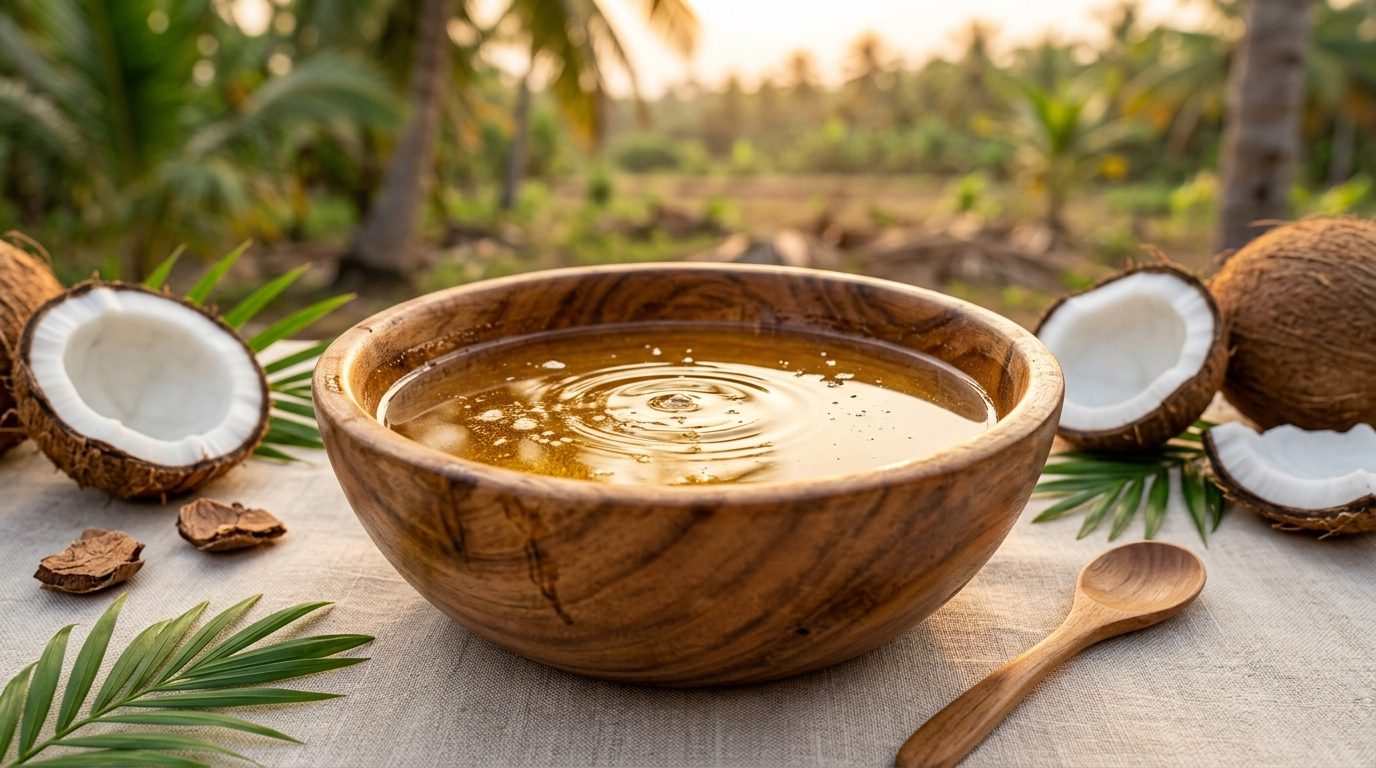
In liquid form (above 25°C), cold-pressed virgin coconut oil should be as visually transparent as spring water (Lovibond Color < 0.5 Red, < 1.0 Yellow). If an exporter offers "Virgin" oil that displays a yellow or amber tint, it has either experienced frictional overheating in an expeller or was pressed from copra rather than fresh wet coconut meat.
3. Biochemical Profiling: Lauric Acid & Free Fatty Acids (FFA)
For laboratory procurement managers, two primary analytical markers establish commercial tiering:
Lauric Acid Retention (C12:0): Lauric acid is a medium-chain fatty acid (MCFA) prized by pharmaceutical, infant nutrition, and dermato-cosmetic laboratories for its antimicrobial, antiviral, and deep cellular penetration properties. In RBN EXIM’s cold-pressed VCO from Tiptur, lauric acid concentrations consistently measure between 50.5% and 53.2%. In expeller oil, thermal shear and oxidation can marginally reduce bioactive monolaurin precursors.
Free Fatty Acid (FFA as Lauric / Oleic): When coconut moisture interacts with native lipolytic enzymes during drying, triglycerides cleave into free fatty acids. Because VCO is pressed from fresh kernel within hours, enzymatic hydrolysis is arrested immediately, keeping FFA strictly below 0.10% (often 0.04% - 0.06%). Expeller copra oil, having undergone extended sun-drying, registers FFA between 0.50% and 1.50%. Higher initial FFA dramatically accelerates rancidity during long ocean voyages.
4. Laboratory Specification Matrix: VCO vs. Expeller Coconut Oil
The following matrix details standard pre-shipment COA parameters for both commodity grades:
| Chemical & Physical Parameter | Cold-Pressed VCO (Virgin) | Mechanical Expeller Oil | Official Test Method |
|---|---|---|---|
| HS Code Classification | 1513 11 00 (Crude / Virgin) | 1513 19 00 (Other / Edible) | WCO Harmonized Tariff |
| Raw Material Origin | Fresh Wet Coconut Kernel | Sun-Dried Tiptur Copra Cups | Physical Origin Verification |
| Processing Temperature | Strictly < 49°C (< 120°F) | 75°C - 95°C (Frictional) | Infrared Thermal Probe |
| Free Fatty Acids (FFA % as Lauric) | < 0.10% (Typical 0.05%) | 0.50% - 1.20% | AOCS Ca 5a-40 |
| Moisture & Volatiles % | < 0.10% (Max 0.15%) | < 0.25% | AOCS Ca 2c-25 / Karl Fischer |
| Peroxide Value (meq O2/kg) | < 1.0 (Ultra Stable) | 1.5 - 3.0 | AOCS Cd 8-53 |
| Lauric Acid (C12:0) Concentration | 50.0% - 53.5% | 46.0% - 49.0% | Gas Chromatography (GC-FID) |
| Color (Liquid State >25°C) | Water-Clear (Lovibond 0.2R) | Light Golden Amber (1.5R) | Lovibond 5¼ inch cell |
| Aroma & Palatability | Fresh, Sweet Natural Coconut | Toasted, Roasted Nutty Aroma | Sensory Panel Evaluation |
| Smoke Point | 177°C (350°F) | 180°C - 190°C | Cleveland Open Cup ASTM D92 |
| Shelf Life Stability | 24 Months (Unopened Ambient) | 12 - 18 Months | Rancimat Accelerated Test |
5. Commercial Application Mapping for Importers
Depending on your end-market formulation requirements, choosing the right grade directly impacts both manufacturing yield and BOM (Bill of Materials) cost:
- Cosmetics, Hair Care & Dermatology: Cold-Pressed VCO is mandatory. Its neutral pH, water-white transparency, and low peroxide value prevent discoloration in white emulsions, body creams, and serums.
- Nutraceuticals, MCT Extraction & Softgel Capsules: Cold-Pressed VCO. The high concentration of caprylic (C8), capric (C10), and lauric (C12) fatty acids provides the cleanest feedstock for fractionation and dietary supplements.
- Gourmet Bakery, Confectionery & Deep-Frying: Expeller Pressed Coconut Oil. Its natural toasted aroma imparts authentic coconut depth to biscuits, roasted snacks, and traditional Asian confectioneries, while its slightly higher smoke point performs robustly in industrial fryers.
- Artisan Cold-Process Soap & Saponification: Both grades perform exceptionally well. Expeller oil provides a cost-effective saponification value (SAP 250-260 mg KOH/g) for high-lather cleansing bars, while VCO is preferred for luxury, hypoallergenic skincare bars.
6. Bulk Liquid Packaging & Ocean Logistics
Transporting bulk vegetable oils internationally requires specialized packaging to prevent oxidation, contamination, and structural leakage:
- 200L Food-Grade HDPE / MS Drums: Packed 80 drums per 20ft container (15.2 to 16.0 MT payload). Drums are hermetically sealed with tamper-evident bungs and food-grade internal epoxy coatings.
- 1000L Intermediate Bulk Containers (IBC Totes): 18 to 20 IBC totes per 20ft container (16.2 to 18.0 MT payload). Features bottom discharge valves and heavy-duty steel perimeter cages for efficient forklift handling.
- 20ft Multi-Layer Flexibags (Bulk Tankers): For large-scale industrial refiners, food processors, and repackagers, single-use food-grade flexibags transport up to 21.5 metric tons in a standard 20ft dry box, cutting freight cost per MT by up to 35% compared to steel drums.